

Virginia’s Deer with Justin Folks: Deer Populations on the Rise
By Justin Folks/DWR
Photos by Meghan Marchetti/DWR
Welcome to the 2026 Virginia Deer Report, where we dive deeper into this past deer hunting season. This summer, we’ll talk about the 2025-26 deer harvest summary, the current deer population status, disease updates, and the importance of doe harvest. We covered the deer harvest summary from last season, and now we’ll be talking about deer population status and disease updates. You can see the 2025 State of the Herd deer report here.
How are we doing from a population standpoint? Things could be better. The map below shows the post-hunt population status on private lands in each county based on our deer population index—the number of antlered bucks killed per square mile of deer habitat in each county. The color of the county indicates its current status (very low to high), the color of the arrow indicates its objective, and the direction of the arrow indicates whether we’re trying to increase or decrease the population in that county. For example, Augusta County currently has a high population status (red) and we’re trying to decrease it to moderate (yellow). A county without an arrow means we are currently meeting the population objective. As of the end of the 2025/2026 season, we need to decrease deer abundance in 56 of 97 counties.
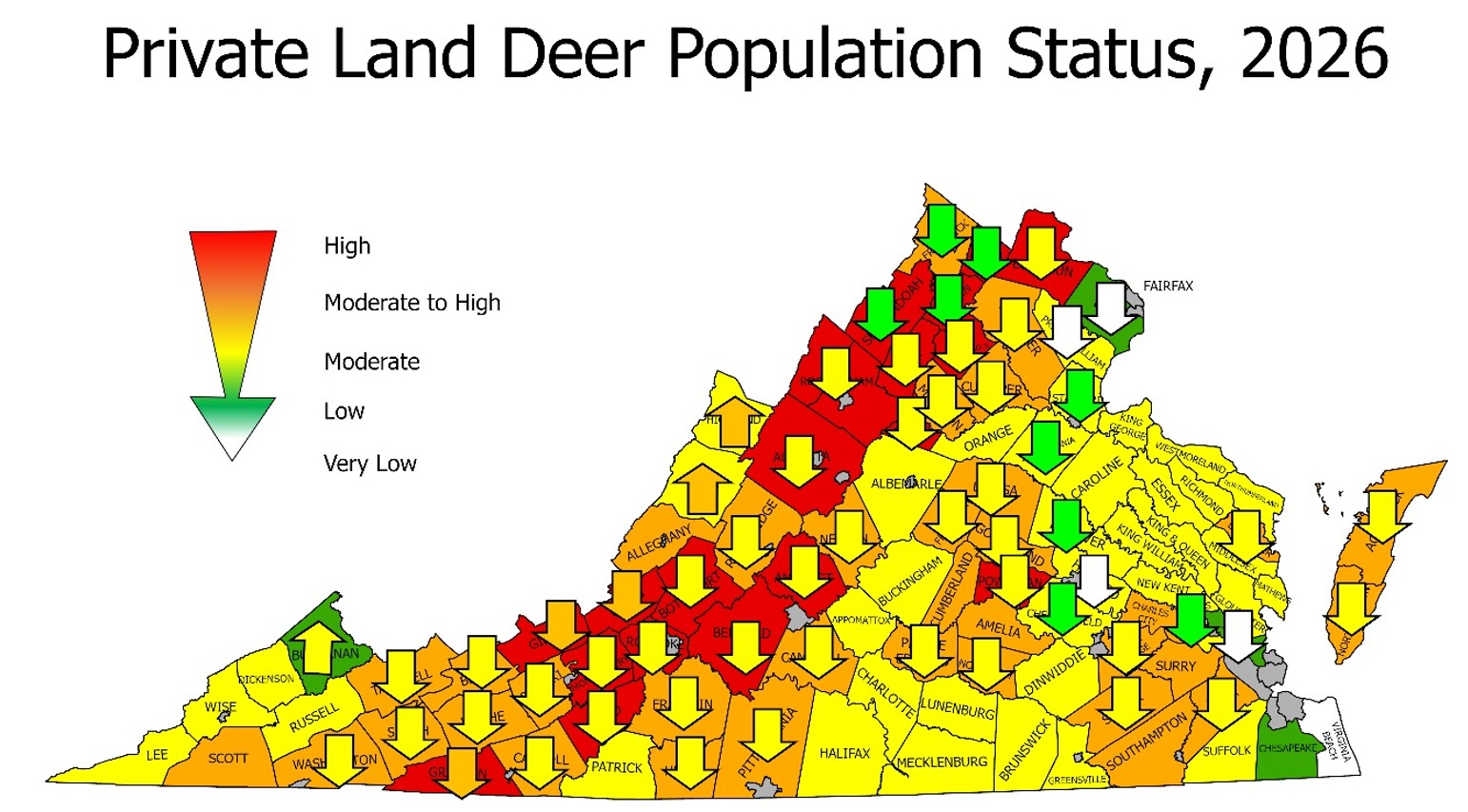
Deer population status, objective, and management goal for private lands by county as of the end of the 2025/2025 deer season. Objectives are currently being met in just 37 of 97 counties.
And here is a map showing the relative abundance of deer on public lands. These values are largely based on deer kill on National Forest lands, especially those West of the Blue Ridge. Our Wildlife Management Areas (WMAs_ and other public lands East of the Blue Ridge are not large enough to provide a meaningful measure of deer abundance. The amount of National Forest land within each county varies quite a bit, but with ~1.7 million acres of the George Washington and Jefferson National Forest in Virginia, we can get a pretty good sense of how deer populations are doing across the Forest.
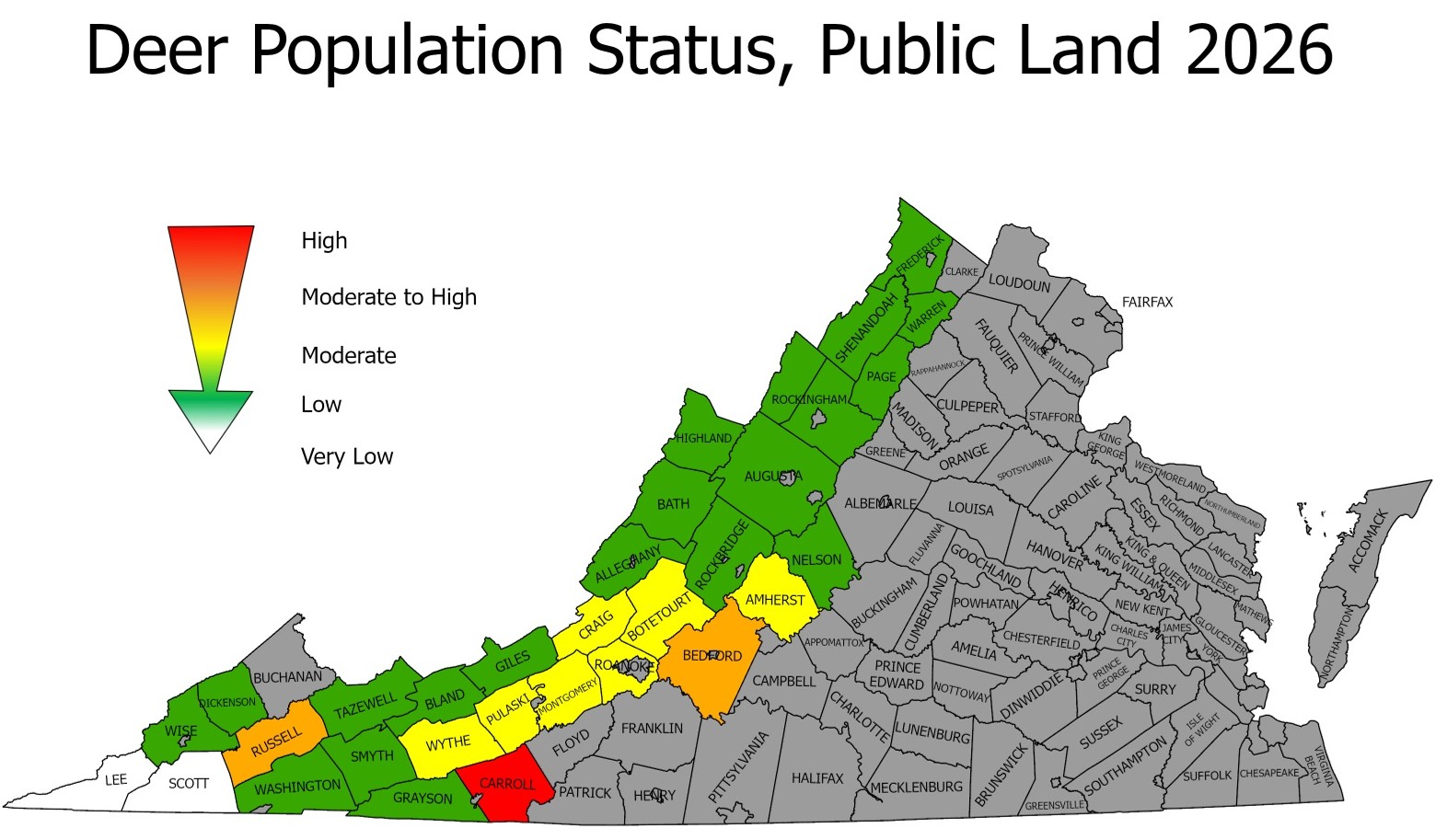
Deer populations look a lot different on public lands than on private lands West of the Blue Ridge, and so do the hunting regulations. The relatively high status values in counties like Bedford, Carroll, and Russell are a factor of the small percentage of public lands present in those counties. The objective is to increase deer populations across public lands.
Following are the statewide deer population estimates from 2004 to 2024. We use something called the Downing population reconstruction method to estimate the statewide population size prior to the hunting season—this is a very coarse look at the overall population, but it allows us to look at statewide trends. The deer population prior to the 2014 season was estimated at about 1.1 million deer, which increased steadily to an estimated 1.3 million deer in 2023 and 2024.
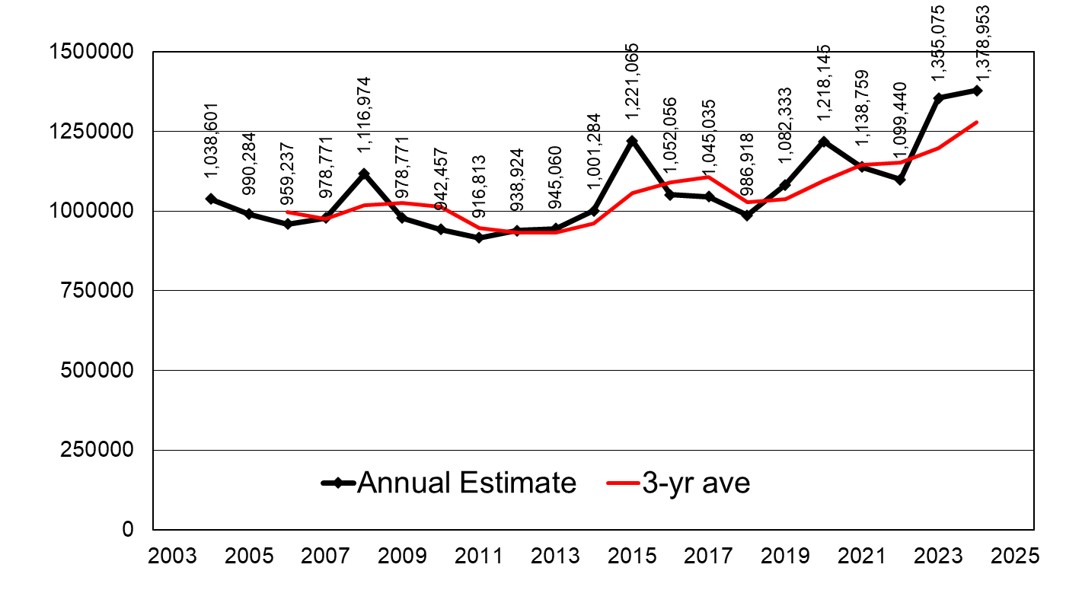
Statewide deer population estimates over the last 21 years. We utilize the Downing population reconstruction method, incorporating harvest data, biological data from DMAP cooperators, and observation data from the annual Bowhunter Survey. The final population estimate is averaged over the three previous years to smooth out variation in the biological/harvest/observational data acquired.
Contrast that population increase with a look at the number of deer hunting licenses sold between 1946 and 2025.
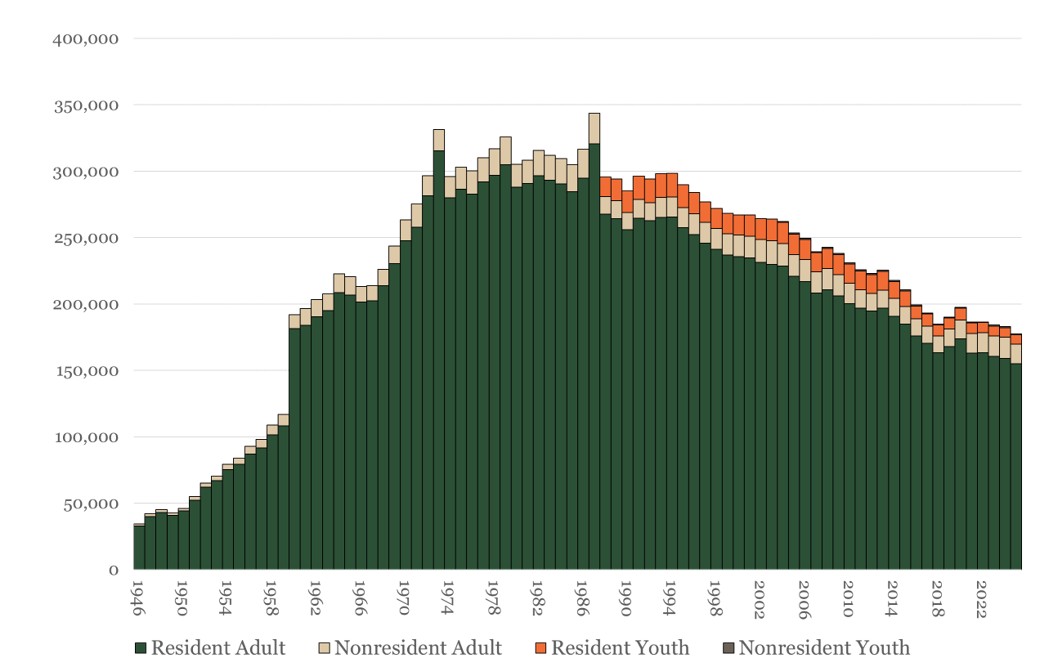
Deer license holders in Virginia since 1946. At our peak, there were more than 343,000 deer licenses sold in 1986. There were just 177,541 deer license holders for the 2025/2026 season. If you haven’t noticed yet, deer numbers are going up and deer hunter numbers are going down. Deer license sales have dropped 19 percent in the last 10 years, and 34 percent over the last 25 years. Many hunters are aging out, and we’re not replacing them. Youth license numbers (orange bars) are declining as well.
While deer hunter numbers are declining, the general population of Virginia is increasing. According to the most recent U.S. Census Bureau population estimate, licensed deer hunters only represent about 2 percent of the total population in Virginia. We don’t have a good handle on the number of hunters exempt from a license, but estimates over the last few years suggest around 17,000-20,000. We estimated almost 39,000 back in 2015.
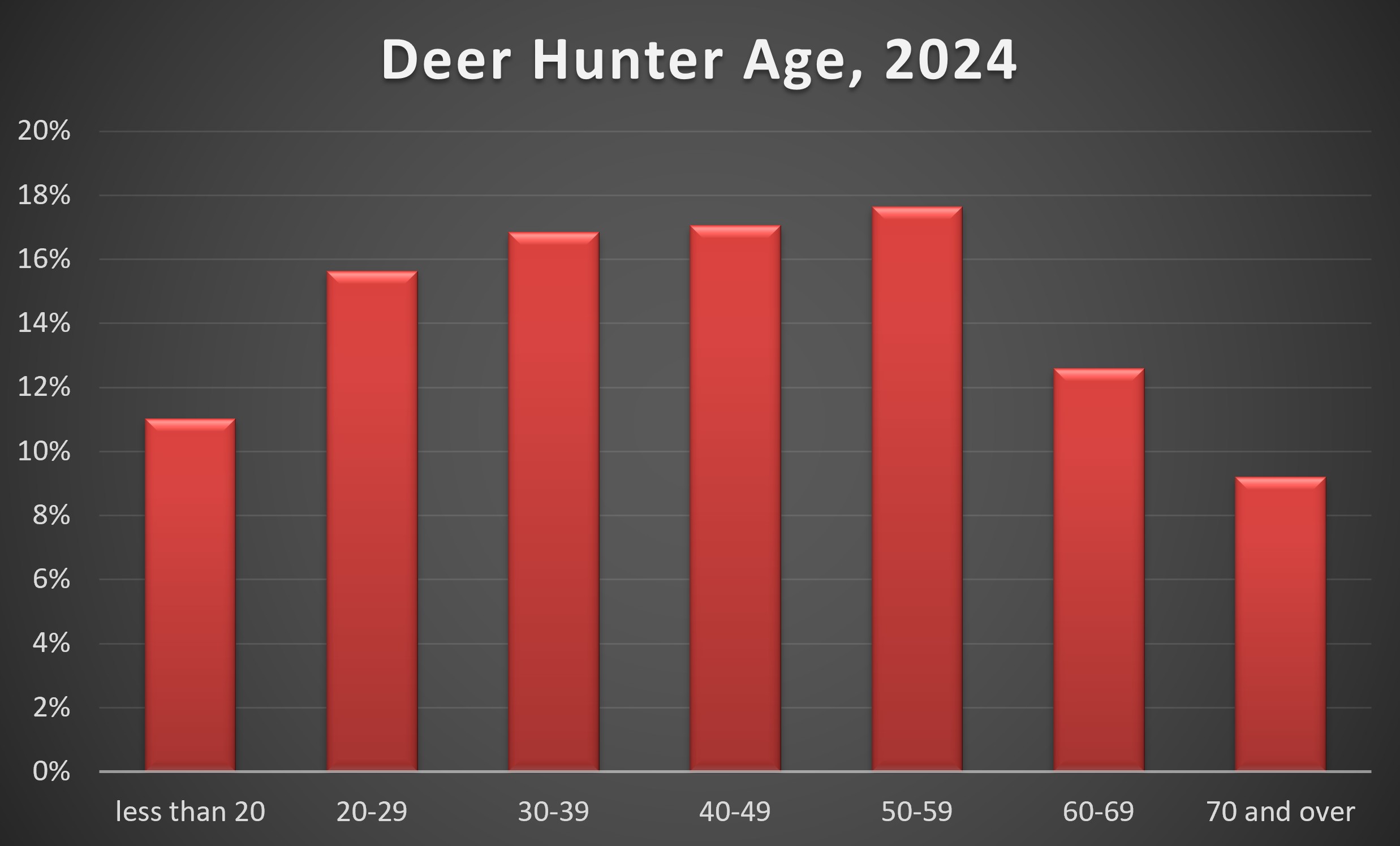
Breakdown of deer hunting license holders by age class. The majority of deer license holders are in older age classes, with far fewer in younger age classes to replace them as they age out. Hunters aged 65 and older are exempt from hunting licenses if hunting on private property in their county/city of residence.
Disease Updates
Epizootic Hemorrhagic Disease (EHD) and bluetongue virus (BTV), lumped together as simply Hemorrhagic Disease (HD), are common viral diseases that are often, but not always, fatal to white-tailed deer. Transmitted by a biting midge in the genus Culicoides, HD becomes more prevalent in late summer and early fall, especially following hot, dry summers that create ideal breeding conditions for the midges. Based on reports through the Wildlife Conflict Helpline and those given directly to DWR, HD activity was fairly quiet last year. We confirmed one relatively small outbreak in northern Virginia and scattered reports of suspect deaths elsewhere in the state that were not confirmed to be HD. While it was quiet in Virginia, HD was big news last year in southeastern Ohio and just across the border in West Virginia. Severe drought in the region set the stage for high midge abundance, and as we’ve seen in Virginia where HD occurs less frequently (like West of the Blue Ridge), the virus tends to be much more lethal to the deer that become infected. Fortunately, deer herds generally rebound within a few years of an HD outbreak.
Despite sampling fewer deer for Chronic Wasting Disease (CWD) than the previous year, we again broke our record for most positives at 126. Sixty (60) of those were in Frederick County alone. Thankfully, none of the positive detections last year will have any implications for creating new Disease Management Areas (DMAs) or adding counties to existing DMAs. In case you didn’t hear, CWD has now appeared on the Delmarva Peninsula. Delaware detected its first (and second) CWD-positive white-tail in Sussex County (their southernmost county). This leaves South Carolina as the only remaining southeastern state yet to detect CWD.
Stay tuned for next month’s blog about how hunters can help with Virginia’s deer population!
Justin Folks is DWR’s Deer Project Leader.
Legal Disclaimer:
EIN Presswire provides this news content "as is" without warranty of any kind. We do not accept any responsibility or liability for the accuracy, content, images, videos, licenses, completeness, legality, or reliability of the information contained in this article. If you have any complaints or copyright issues related to this article, kindly contact the author above.
